
Healing Tears
by Sabene Rizvi
Bright Before Us Writing Contest Honorable Mention
Most people don’t start a personal essay by sharing that the past week has been incredibly emotional—crying at a party, at a conference, at home, but I am doing so— with you, in this piece, and in this regard, I thank these very United States, which I sometimes feel so scared of.
My name is Sabene Rizvi. I am twenty-one years old. I am a quadruple major at Purdue University Fort Wayne. I am a Computer Scientist in training. I am a Political Scientist in training. I am Pakistani-American. I identify as Queer. My inherited religion is Islam. I am a woman, and oftentimes in political spaces, not all my identities are welcome to breathe—whether that be my femininity, my engineering, my Pakistani-American identity, my queer identity or my inherited religion of Islam. This past week has been strange in that very regard.
Today is January 31, 2026. To most people, it is just a date. To me, it marks thirteen years since my Baba (dad) passed away. It is the day my trauma officially becomes a teenager. Thirteen years since I could no longer sit in my dad’s lap when he came home from work, or count the stars with him in our backyard at 8 p.m. every night. Thirteen years since the masculine protection that shielded me—from, ironically, masculinity—was gone. Thirteen years of yelling, screaming, threats, violence, shoe throwing, knife chasing, head bashing. Today marks the internalization of the end of those thirteen years. It marks the understanding that it’s over, no one is going to hurt me. I am free.
My body cultivates between tears, breaths and shakes late at night; my cabeza (head) feels heavy during the day. I write today with my tears, not to bury them as I did at sixteen.
Acceptance. That one word is breath. It is the falling of armor. It is the creation of love, hugs, tears, and internalization.
Two days ago, at a “Meet the Candidate” event I helped organize, I raised my hand and said: “I am a first generation American. I am queer. I am a person of color. I am a woman. I have been chronically ill since I was sixteen. I have been on Medicaid since I was seventeen. I am also Muslim. What is the one thing you can do in the next week to give a person like me hope in this political environment?".
Kelly Thompson, a congressional candidate and ally, replied:
“Can we get lunch, Sabene? Can we get lunch so I can understand, Sabene?”
She added “You are all here too”, but then addressed me directly: “I am speaking to you, Sabene”. My body still processes those words. Understand. Sabene. Sabene can say all that about herself, and be met with a request for lunch—not a shoe, not an attempt to push oneself in through a cracked door, not the grimace of a lie. Just lunch.
Just lunch. As a Pakistani, the way my people connect is through food, and this was a moment of connection, from a white MawMaw with the slogan “Run like a mother”.
On January 23rd, 2026, I presented “From COINTELPRO to Queerphobia: How the State Policies Resistance” at Creating Change 2026. Over five days, the words “we are creating change” echoed repeatedly. Change is a gift. A gift I received throughout the conference. I presented alongside another Queer Pakistani-American Muslim sharing how Queer and Trans
Muslims face the brunt of Islamophobia, and state surveillance in the United States. The next day, I co-facilitated “Thrive, Survive, Strategize: Community Organizing Workshop” with two Queer Pakistani-American Muslims. Reading narratives of Queer Muslims in that room, I cried. I remembered being those very stories. I walked away knowing I wasn’t alone.
Men. Pakistani men. I have a fear of them. I remember walking the streets of Lahore at fourteen, my breasts ogled by strangers. Yet my co-facilitators and representatives at the conference, also Pakistani men, offered hugs. They gave agency.
Ashi. I learned this word in Ethiopia two years ago. It means yes, understood. I was visiting my mother and helping her boss set up a Linktree for a conference. That evening, as I climbed the stairs of a restaurant in Addis Ababa, a hand briefly landed on my lower back. It was the hand of an older gentleman my mother had introduced me to earlier. I froze. I was afraid, but I kept climbing. The hand stayed only long enough to catch me. It wasn’t a threatening touch. It was a safe hand. A hand to support me. As I climbed that last step, the hand removed itself.
Later in the week, I walked the streets of Addis Ababa. My mother was taking pictures of me at Meskel Square when an older man approached and asked if he could take a picture with me. Protective, my mother declined and moved us away. The man let it go. Harmless. Respectful. Outside a grocery store, an Ethiopian teenager waved at me. I waved back. He grinned and walked on. Soft. Cute. Harmless. Safe.
In many societal systems, danger is assumed to come from the foreigner, the unknown, often the Black male. In Pakistani systems, it is assumed that feminine impurity happens from the foreign male. I thought I knew Pakistani men. The system had taught me to fear other men, to mistrust physical space. In Ethiopia, I experienced a male that offered acceptance, understanding, respect, joy, bodily autonomy. Consent exists in the simplest of gestures, in the word Ashi. It was embedded into my experience of Ethiopia, and of Addis Ababa.
Since returning to the United States, I carry the memories and the sense of consent of Ethiopia with me. Nine days ago, I reunited with a friend I hadn’t seen in months. He saw me as he was climbing up the street. He yelled “Sabene! Sabene!” with great excitement. Laughter comes to mind when I remember.
I talked my heart out with him. Later, back at my hotel, I felt embarrassed. Internally, I thought, “Why’d I say all that? Why’d I talk so much?” It’s because I could. We talked about siblings, a personal question followed, I answered truthfully. I felt obligated to explain my answer. Stuttering, I said, “I-uhh…” My friend smiled and said, “Nah, don’t worry about it,” and changed the conversation. When I speak of Radical Kindness, Radical Correction, and Radical Change, this is what I mean: a nice person whose care for you outweighs curiosity. A person to whom you are kind, not curious.
When I moved to Fort Wayne at seventeen to begin life anew, and when I started school, I imagined four years of classes and mundane friendships that would fade after graduation. Well—that’s not what happened. Here I am with two more years of school to go, a life-time of memories, friendships and the acceptance of protection. When a past abuser recently threatened to break my legs, my mind went:
“He can’t. He can’t access me here. I am safe here. I have friends here. I have a community here. I have people to protect me”
Drag queens, queer people and MawMaws can fight.
My door is locked. My bed is safe. A door stands between me and my abuser, and it is locked. I have the key. I am not letting him in because I don’t need his “love”. I have love. In the hand on my back. In the friend yelling my name. In the drag queens of After Dark Fort Wayne.
I have never been harassed by a drag queen, a transgender person or a gay person. I have been harassed by a straight white male peer, but when I told my professors, they protected me. Not him. Me. That was two years ago. Recently, I asked one of my professors if he’d be willing to write me a letter of recommendation for a scholarship and he said “I’d be thrilled to, Sabene”. Telling the truth, asking for protection, being protected, it came at no cost this time.
Compare this to when I finished high school, and a former teacher who had written me a recommendation letter harassed a friend who had just turned eighteen. Compare that to the story of a fellow Pakistani woman, whose brother dismissed a death: “Well, he didn’t say it in front of me.” Compare that to now, and you find kind, protective, older men—who want what’s best for you.
I have always believed in Mera Jism, Meri Marzi (my body, my choice). I even considered making a sticker that says Mera Jism, Meri Marzi Supremacy, but Mera Jism, Meri Marzi doesn’t just apply to abortions or sex. It applies to the way you carry yourself in the world. In the friends you make. In the things you say. In the things you write. In breaking the rules of a so-called God-loving society.
I call on my friends because I can. Stuck at an airport, dishwasher broken, homework help, call them. I push them to be better: sleep more, eat, take your medication. Strength and softness exist together. Crying isn’t inherently weak. Sometimes, the best strength friendships and community offer is simply letting you cry, with no danger in sight.
Remember your Radical Kindness is for the person, not for a performance. And remember, it is for yourself too.
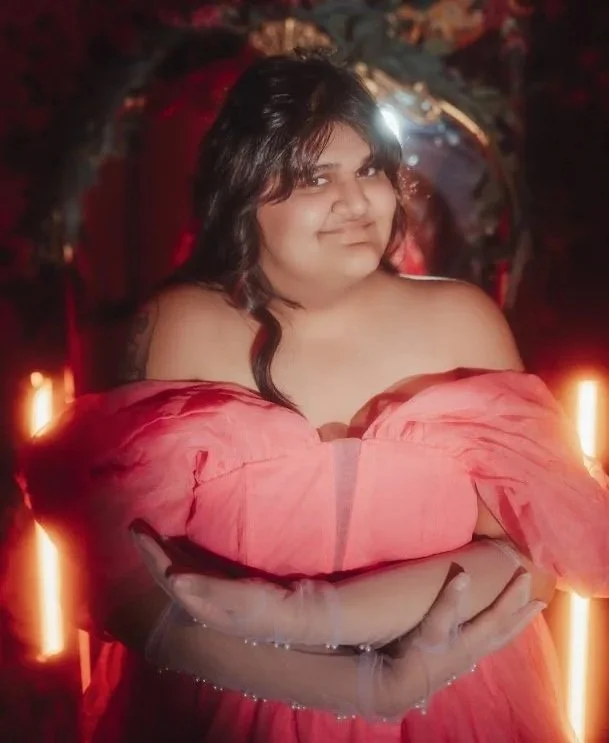
Sabene Rizvi (she/they) is a first-generation Pakistani American and fifth-year undergraduate at Purdue University Fort Wayne pursuing a quadruple major. Their work explores the intersections of artificial intelligence, reproductive justice, and democratic governance, centering human dignity and lived experience. Sabene has spoken on panels hosted by UNITAR and the Global Center for Rehumanising Democracy, as well as events organized by the ACLU of Indiana, All-Options, and Planned Parenthood. Inspired by passion and perseverance, Sabene created Healing Tears to honor their own story, their late father, their dear friend McKenna, and the messy journey of healing. Sabene chose to write this piece in English, the language of her home; Urdu, the language of her roots; and Spanish, a language that has expanded her understanding of the world and herself.